Opening times:
Mon – Fri 8am – 8pm | Sat 9am – 5pm | Sun 10am – 4pm |
Mon – Fri 8am – 8pm | Sat 9am – 5pm | Sun 10am – 4pm |
Call Us:
0800 246 5538

Mon – Fri 8am – 8pm | Sat 9am – 5pm | Sun 10am – 4pm |
Mon – Fri 8am – 8pm | Sat 9am – 5pm | Sun 10am – 4pm |
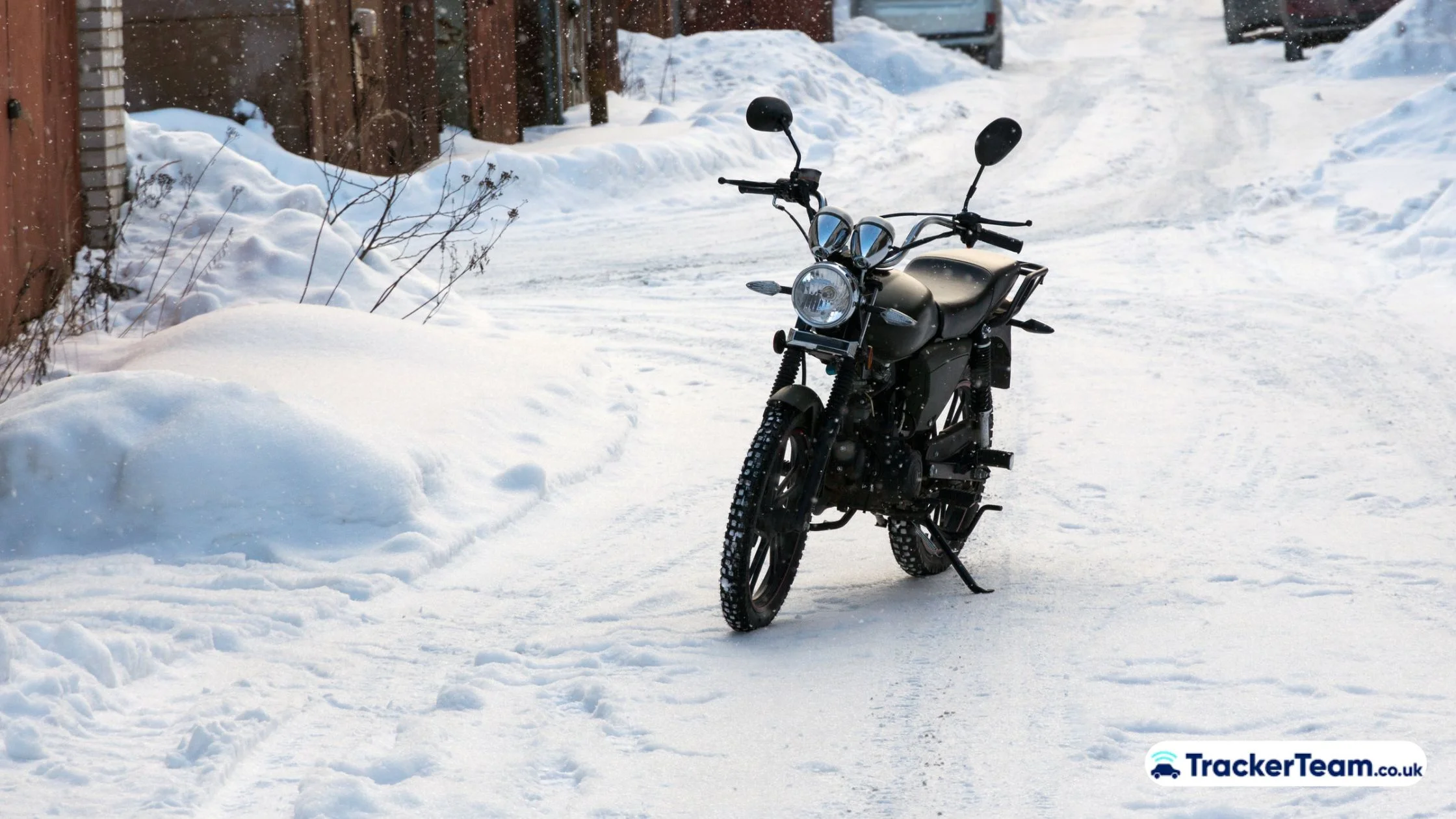

No, a tracker shouldn’t drain your bike battery over winter, as long as it’s a quality unit that’s been installed correctly. Thatcham Approved Trackers designed for motorcycles enter a low-power sleep mode when your bike is parked, typically drawing less than 1mA. That’s a tiny load compared with the capacity of a standard bike battery. Where riders do find a flat battery after winter, the real causes are usually cold temperatures, natural self-discharge or a battery that’s nearing the end of its life. Pairing your tracker with a smart battery optimiser solves the problem completely.
Motorbike trackers are built with small batteries in mind. When the ignition is off and the bike isn’t moving, the tracker switches into sleep mode. GPS and most other components power down, while the motion sensors stay alert, ready to wake the unit the moment the bike is moved.
Here’s what that looks like in practice:
At 0.5mA, a tracker uses around 12mAh a day. Over 120 days of winter storage, that’s roughly 1.4Ah. Most motorbike batteries hold somewhere between 6Ah and 20Ah, so a properly working tracker uses only a modest share of the charge over an entire season.
If your bike won’t start in March, the tracker is rarely the main culprit. Several factors combine during a lay-up.
Batteries lose capacity in the cold. A battery that starts the bike easily in summer can struggle on a frosty morning, even if it still has charge.
All batteries slowly lose charge on their own, even when nothing is connected. Over several months, self-discharge alone can leave a lead-acid battery too weak to crank the engine.
Modern bikes have clocks, ECUs, alarms and immobilisers that draw a small current when parked. Add these together with a tracker and self-discharge, and the total adds up over a long lay-up.
Batteries typically last a few years. An older battery has less usable capacity, so the same small loads flatten it far sooner.
A tracker that doesn’t drop into sleep mode correctly, or one that’s been wired to a permanent live feed incorrectly, can draw many times more than it should. This is why professional installation matters. If you suspect a problem, a quick current draw test will show whether your tracker is behaving as expected.
When choosing from our range of Thatcham Approved Trackers, you get units designed for low standby draw, fitted by trained engineers so they sleep properly when your bike is parked.
It’s tempting, but it’s not a good idea with a tracker fitted. Here’s why:
The simplest solution is a smart battery optimiser, sometimes called a trickle charger or battery maintainer.
A quality motorbike tracker in sleep mode typically draws less than 1mA, with some units drawing around 0.4mA.
Yes. Leaving it connected keeps your bike protected and avoids tamper alerts. Use a battery optimiser to keep the battery topped up.
Not on its own if it’s working correctly. Cold, self-discharge, the bike’s other electrics and battery age are far more likely causes.
A rapid drain usually points to a fault or an installation issue. Contact your installer to test the current draw and check the wiring.
Most Thatcham trackers have an internal backup battery that keeps them working for a limited period, but this will eventually run down too. Keeping the main battery charged is the best way to stay protected.
Yes. Stored bikes are often left unchecked for weeks, making them attractive to thieves. A monitored tracker alerts you if the bike is moved.
A properly fitted tracker won’t flatten your battery, and with a smart optimiser connected, your bike will be protected through the coldest months and ready to ride in spring. Explore our full range of Thatcham Approved Trackers with professional installation for motorcycles and scooters.